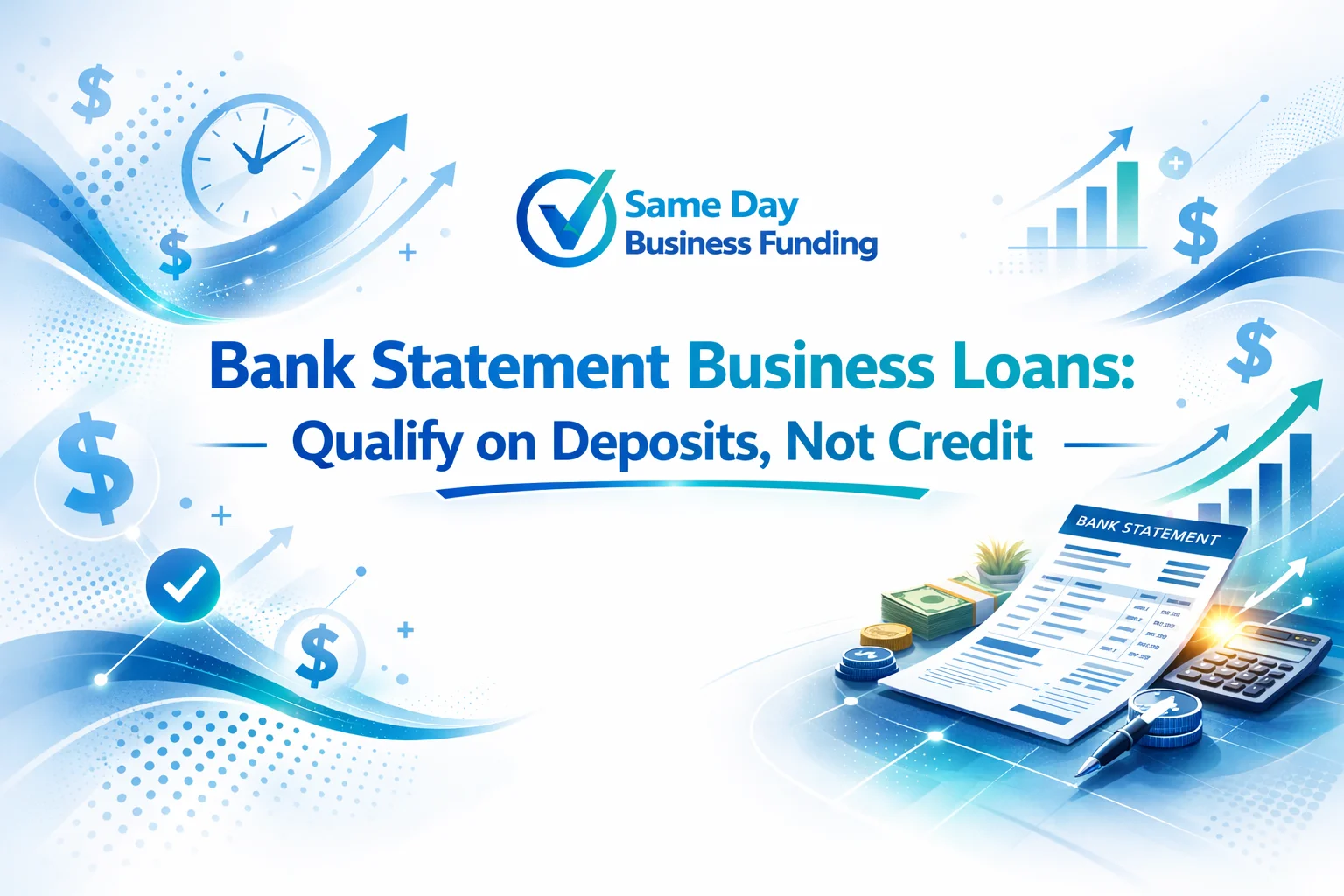
Bank statement business loans let you qualify for funding based on the money flowing through your business bank account — not your personal credit score. Instead of pulling your credit report and making a decision based on a three-digit number, bank statement lenders analyze 3–6 months of deposits, cash flow patterns, and account activity to determine whether your business can support a loan.
This approach to underwriting exists because traditional credit scores don’t tell the full story for many business owners. Self-employed borrowers, cash-heavy businesses, owners recovering from past financial setbacks, and businesses with strong revenue but poor personal credit all share the same problem: their bank account shows a healthy business that their credit report doesn’t reflect.
If that sounds familiar, a bank statement loan may be one of the fastest paths to funding you’ll find. Here’s exactly how they work, what lenders look for in your statements, how to qualify, and how to get the best terms.
How Bank Statement Business Loans Work
The concept is straightforward. Instead of relying on credit scores, tax returns, and financial statements to evaluate your loan application, bank statement lenders use your actual bank account data as the primary qualification tool.
The process:
You submit 3–6 months of business bank statements along with a simple application. The lender’s underwriting system analyzes your deposits, average daily balance, cash flow consistency, and account health. Based on that analysis, they determine your approved loan amount and terms — typically within hours.
What lenders calculate from your statements:
Your average monthly deposits — this is the most important number. It tells the lender your gross revenue and determines your maximum loan amount. Most bank statement lenders offer 1x to 2.5x your average monthly deposits.
Your cash flow consistency — lenders look for regular, predictable deposits rather than sporadic large sums. A business that deposits $40,000–$50,000 every month is a stronger candidate than one that deposits $10,000 one month and $90,000 the next, even though the average is similar.
Your average daily balance — this shows whether you maintain a financial cushion or whether your account frequently drops near zero. Higher average balances signal lower risk.
Your overdraft and NSF history — frequent overdrafts, returned payments, or negative balances are red flags that can reduce your approved amount or disqualify you entirely. Occasional overdrafts aren’t necessarily deal-breakers, but a pattern is.
Who Benefits Most From Bank Statement Loans
Bank statement loans aren’t for everyone — but for certain business owners, they’re the best available option by a wide margin:
Self-employed business owners whose personal credit doesn’t reflect their business success. Many self-employed owners have lower credit scores because they carry business expenses on personal accounts, have high credit utilization from business spending, or went through a rough patch years ago that still weighs on their score.
Cash-heavy businesses like restaurants, retail stores, salons, construction companies, and service businesses that generate strong daily revenue but may not have the formal financial documentation that banks require.
Business owners recovering from financial setbacks. Bankruptcy, foreclosure, divorce, medical debt — these events crush a personal credit score for years, but they don’t necessarily reflect how your business performs today. Bank statement lenders evaluate your current business health, not your past personal financial history.
Businesses with non-traditional income. If your revenue doesn’t fit neatly into a W-2 or standard tax return — multiple income streams, 1099 contractor income, seasonal fluctuations — bank statement lending captures your actual financial picture more accurately.
Newer businesses with limited credit history. A business that’s been operating for 6–12 months may not have an established business credit profile yet, but bank statements can show strong and growing revenue that justifies funding.
What Lenders Look For in Your Bank Statements
Understanding exactly what lenders evaluate helps you prepare — and potentially improve — your application before you submit it.
Consistent deposits. Regular, recurring deposits show a stable revenue stream. Lenders prefer seeing steady income throughout the month rather than one or two large deposits. If your business receives payments in batches (like bi-weekly client payments), that’s fine — the key is predictability.
Growing or stable revenue trends. Lenders comparing month-over-month deposits prefer to see stable or increasing revenue. A declining trend over 3–6 months raises concerns about your ability to repay.
Positive average daily balance. Keeping a reasonable balance in your account — rather than spending every dollar as it arrives — demonstrates financial management and gives lenders confidence. There’s no magic number, but consistently maintaining a balance above $1,000–$5,000 (depending on your revenue level) is a positive signal.
Minimal overdrafts and NSF items. Overdraft transactions signal that your business spends more than it brings in during certain periods. One or two over several months usually won’t disqualify you. Five or more in a single month almost certainly will.
Low or manageable existing loan payments. Lenders look at outgoing payments to other lenders to calculate your existing debt obligations. If your current loan payments consume a large percentage of your deposits, there may not be enough room for an additional payment.
Legitimate business activity. Deposits should come from identifiable business sources — customer payments, card processing, ACH transfers. Large unexplained cash deposits or transfers from personal accounts can raise compliance questions.
Apply Now – Qualify Based on Your Deposits, Not Your Credit →
Bank Statement Loans vs. Traditional Business Loans
The differences between bank statement lending and traditional bank loans go beyond just the qualification criteria:
Qualification basis: Bank statement loans use deposits and cash flow. Traditional loans use credit scores, tax returns, and financial statements. If your bank account is stronger than your credit report, bank statement loans give you a fairer evaluation.
Documentation: Bank statement loans require your application plus 3–6 months of statements — documents you can download from online banking in minutes. Traditional loans require tax returns (often 2+ years), profit and loss statements, balance sheets, business plans, and sometimes collateral documentation. The paperwork alone can take days to compile.
Approval speed: Bank statement loans approve in hours, sometimes minutes, because the analysis is largely automated. Traditional bank loans take 2–8 weeks because humans review extensive documentation. SBA loans can take 30–90 days.
Funding speed: Bank statement loans fund same day to 3 business days. Bank loans fund after weeks of processing.
Cost: Bank statement loans carry higher rates than traditional bank loans — factor rates of 1.1–1.5 or APRs of 15–60% compared to 6–13% for bank loans. You’re paying a premium for accessibility and speed.
Approval rates: Bank statement lenders approve a significantly higher percentage of applicants because their qualification criteria are designed to be inclusive. At Same Day Business Funding, our approval rate is 95% for qualified applicants.
How Much Can You Borrow With a Bank Statement Loan?
Your approved amount is directly tied to your bank statement data. Here’s the general framework most lenders use:
1x to 2.5x your average monthly deposits. If your business deposits an average of $30,000 per month, you could qualify for $30,000 to $75,000. Businesses with $100,000 in monthly deposits could access $100,000 to $250,000.
Factors that increase your approved amount: Consistent deposits month-over-month. Growing revenue trends. High average daily balance. Clean account history (no overdrafts). Strong time in business (12+ months). No existing heavy debt obligations.
Factors that decrease your approved amount: Declining revenue trends. Frequent overdrafts or NSFs. Very short time in business (under 6 months). Large existing loan payments. Irregular deposit patterns.
Maximum funding: Most bank statement lenders offer up to $500,000–$1,000,000 for businesses with strong enough deposits to support it.
Qualification Requirements
Bank statement loans have some of the most accessible requirements in business lending:
Time in business: 3–6 months minimum for most lenders. Some require 6–12 months for larger amounts.
Monthly revenue: $10,000+ in average monthly deposits for most lenders. Higher deposits unlock higher loan amounts.
Bank account: An active business checking account in good standing. Most lenders want to see at least 3 months of history.
Credit score: No minimum for many bank statement lenders. Some may use your score as a secondary factor but won’t decline you based on credit alone. This makes bank statement loans one of the most accessible options for borrowers with bad credit.
Industry: Most industries qualify. Some lenders restrict certain high-risk categories, but the vast majority of businesses are eligible.
Get Approved in Minutes – No Credit Score Minimum →
How to Strengthen Your Bank Statement Loan Application
Even though bank statement loans are more accessible than traditional financing, you can still improve your odds and terms with these strategies:
Clean up your account 60–90 days before applying. Since lenders evaluate your most recent 3–6 months of statements, the window you submit matters. Reduce overdrafts, maintain higher balances, and deposit revenue consistently during this period. Think of your bank statements as a financial resume — you want the best version possible.
Deposit all revenue through your business account. If you receive cash payments, deposit them regularly. If customers pay via multiple channels (Venmo, Zelle, cash, checks), route everything through your business account. Lenders can only evaluate what they can see — revenue that doesn’t hit your bank account doesn’t count toward your qualification.
Avoid large unexplained transfers. Moving money between personal and business accounts, receiving large deposits from non-business sources, or making large unexplained withdrawals can trigger compliance concerns and slow down your application.
Reduce existing debt payments before applying. If you’re currently making large payments on other business loans, paying down or paying off those obligations before applying frees up cash flow and increases your approved amount.
Apply with multiple lenders. Bank statement loan terms vary significantly between lenders. Applying with 2–3 lenders gives you comparison points. Most use soft credit checks, so comparing offers won’t hurt your score. Read our guide on easy business loans for more strategies on comparing lender offers.
Common Uses for Bank Statement Loan Funds
Bank statement loans are unrestricted — you can use the capital for any business purpose:
Working capital and cash flow management. Cover operating expenses during slow periods, bridge gaps between invoicing and payment, or maintain working capital during seasonal fluctuations.
Inventory purchases. Stock up before busy seasons, take advantage of bulk pricing from suppliers, or fulfill large orders that require upfront material costs.
Payroll. Ensure employees are paid on time even when receivables are slow or revenue is temporarily dipped.
Equipment and supplies. Purchase or upgrade business equipment, technology, vehicles, or other operational necessities.
Marketing and growth. Fund advertising campaigns, hire additional staff, expand to new locations, or invest in business development.
Emergency expenses. Handle unexpected repairs, legal costs, tax obligations, or other surprise expenses that can’t wait for traditional bank loan processing.
Frequently Asked Questions
Are bank statement loans only for bad credit borrowers?
No. Bank statement loans are used by business owners across the credit spectrum. Some borrowers have excellent personal credit but prefer the simpler documentation process. Others are self-employed and find that bank statement evaluation gives a more accurate picture of their business than a traditional credit check. Bad credit borrowers benefit the most because the qualification criteria bypass their primary barrier — but anyone can use them.
Can I use personal bank statements instead of business statements?
Some lenders accept personal bank statements if your business revenue flows through a personal account, but this is less ideal. Business bank statements give lenders a clearer picture of your commercial activity and are strongly preferred. If you don’t have a separate business account, opening one and running 3 months of activity through it before applying will improve your options significantly.
How many months of statements do I need?
Most lenders require 3 months minimum. Some request 6 months, especially for larger loan amounts. Having 6 months ready to go is the safest approach — it gives you flexibility to apply with any lender and shows a longer performance track record.
Will a bank statement loan show up on my credit report?
It depends on the lender. Some alternative lenders report to business credit bureaus, which can actually help build your business credit over time. Most do not report to personal credit bureaus. Ask your lender about their reporting practices before accepting an offer if this matters to you.
How fast can I get funded with a bank statement loan?
Most bank statement lenders offer same day to next-day funding. The application process takes 2–10 minutes, and approval can happen within hours. Having your bank statements downloaded and ready before you start is the best way to ensure the fastest funding.
What if my bank statements show a slow month?
One slow month in an otherwise consistent pattern usually isn’t a problem — lenders understand that businesses have natural fluctuations. The overall trend across 3–6 months is what matters. If your most recent months are stronger than earlier ones, that’s actually a positive signal showing growth. If you’re in a slow period now, consider waiting until you have a stronger recent month before applying.
Get Your Bank Statement Business Loan Today
Bank statement loans exist because credit scores don’t capture the full picture of every business. If your bank account tells a different story than your credit report — stronger revenue, consistent deposits, a healthy operating business — bank statement lending lets that story be heard.
At Same Day Business Funding, we evaluate your business based on your actual performance, not a credit score. Our application takes less than 2 minutes, we require no minimum credit score, and we can approve and fund your business the same day you apply. Over 2,500 businesses have trusted us with more than $100 million in funding over the past 10+ years.